 In three days, July 1, 2026, two things happen simultaneously that every Canadian real estate watcher should have on their radar.
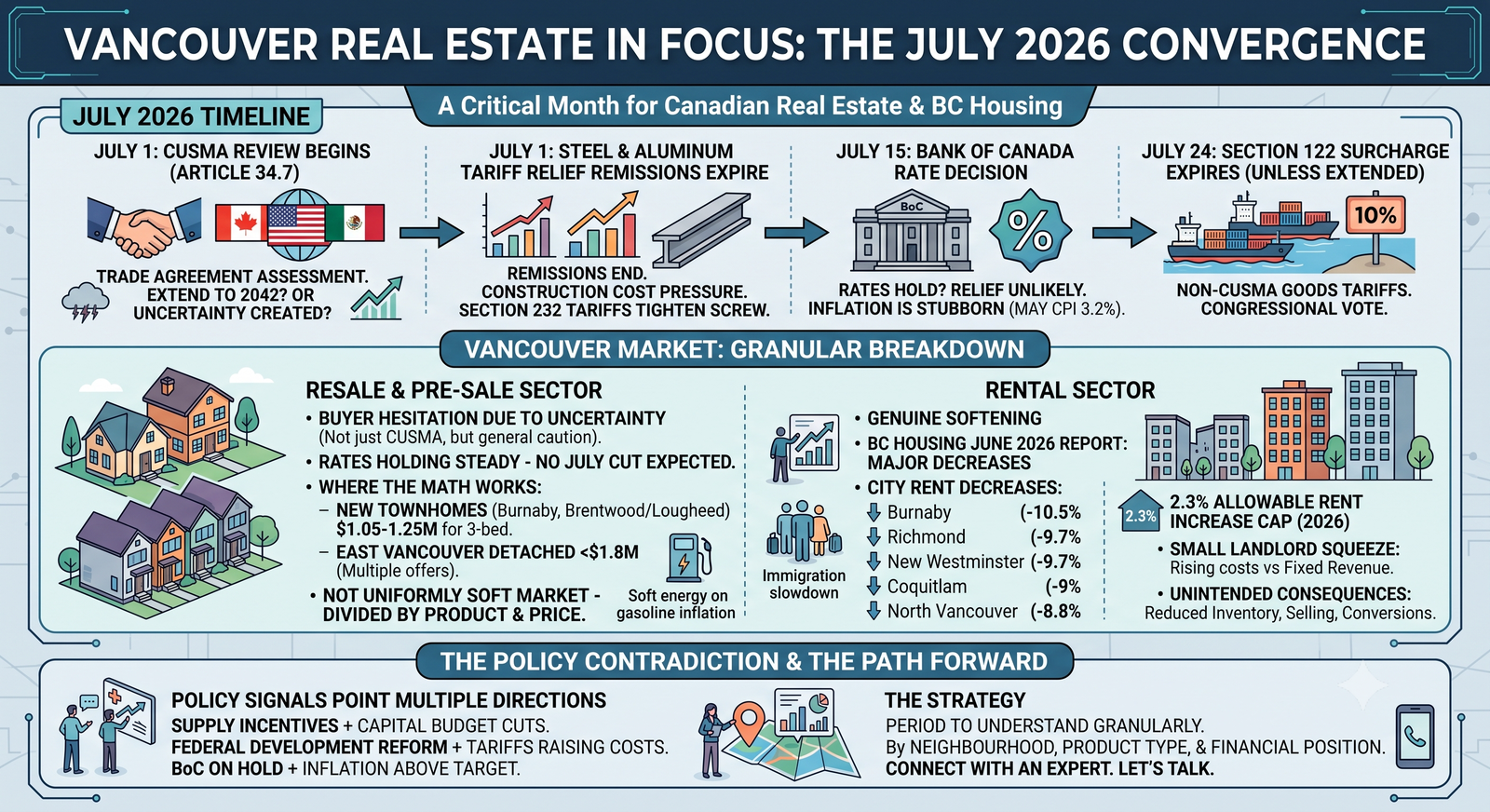
First: the formal CUSMA review begins. Six years after the Canada-U.S.-Mexico Agreement took effect, the three parties are obligated under Article 34.7 to sit down and assess how the deal is working. If they agree in writing to extend it, CUSMA runs to 2042. If they don't — or if the U.S. uses this as leverage — the uncertainty that's already been dragging on Canadian growth gets a new chapter.Second: tariff relief remissions on aluminum and steel goods expire.
That's not an abstraction for the housing sector. Steel and aluminum are already under 50% Section 232 tariffs. The expiry of remissions tightens the screw further on Canadian construction costs at exactly the moment the federal and provincial governments are trying to accelerate new supply.
Then, on July 24, the 10% Section 122 surcharge on non-CUSMA compliant goods is also set to expire — unless Congress votes to extend it. The Bank of Canada's next rate decision follows on July 15. So between now and the end of the month, the macro picture clarifies or gets messier. Either way, there's movement.
Here's the part that matters for the Vancouver market specifically. The trade uncertainty has been a direct contributor to buyer hesitation — not because buyers are thinking about CUSMA provisions, but because uncertainty makes people cautious. And the energy shock layered on top has made the BoC's job harder. May CPI came in at 3.2%, with gasoline inflation running at 33% year-over-year, a direct consequence of the Iran war disrupting flow through the Strait of Hormuz. That's the highest headline inflation since September 2023. The BoC cannot cut into that. So the rate relief some buyers are counting on for July isn't coming.
What this means in practice: the buyers who are going to move will move because the math works at current rates, not because they're waiting for a cut. And the math increasingly does work. New townhome developments in Burnaby's Brentwood and Lougheed corridors are pricing in the $1.05–1.25M range with three bedrooms. East Vancouver detached under $1.8M is seeing multiple offers in certain price bands. The market isn't uniformly soft — it's sorted by price and product type.
The rental side is genuinely notable this month. BC Housing's June 2026 rental report showed six BC cities among Canada's top 15 for the largest rent decreases: Burnaby down 10.5%, Richmond down 9.7%, New Westminster down 9.7%, Coquitlam down 9%, North Vancouver down 8.8%. That's significant softening, driven by the immigration slowdown pulling the demand floor out from under the rental market's 2022–2024 trajectory.
The 2.3% allowable rent increase cap for 2026 (tied to CPI) is protecting sitting tenants, but LandlordBC is pushing back hard — and not without reason. Small landlords are absorbing rising maintenance costs, property taxes, and insurance against a fixed revenue ceiling. That squeeze is showing up in decisions not to rent, decisions to sell, or decisions to convert. The unintended consequences of the cap will surface in inventory data over the next 12–18 months.
The through-line here is that we are in a period where policy signals are pointing in multiple directions at once: supply incentives being added while budget cuts simultaneously reduce the province's housing capital by $1.4 billion; federal development charge reform alongside tariffs making those same developments more expensive to build; a BoC on hold while inflation is technically above target.
This is not a market to interpret from the sidelines. It's a market to understand granularly — by neighbourhood, by product type, by your specific financial position.
That's the conversation I'm having with clients every day this week. If you want in on it, reach out.
Kevin Lynch
Sutton Centre Realty
hello@kevinlynch.ca
604-307-9448