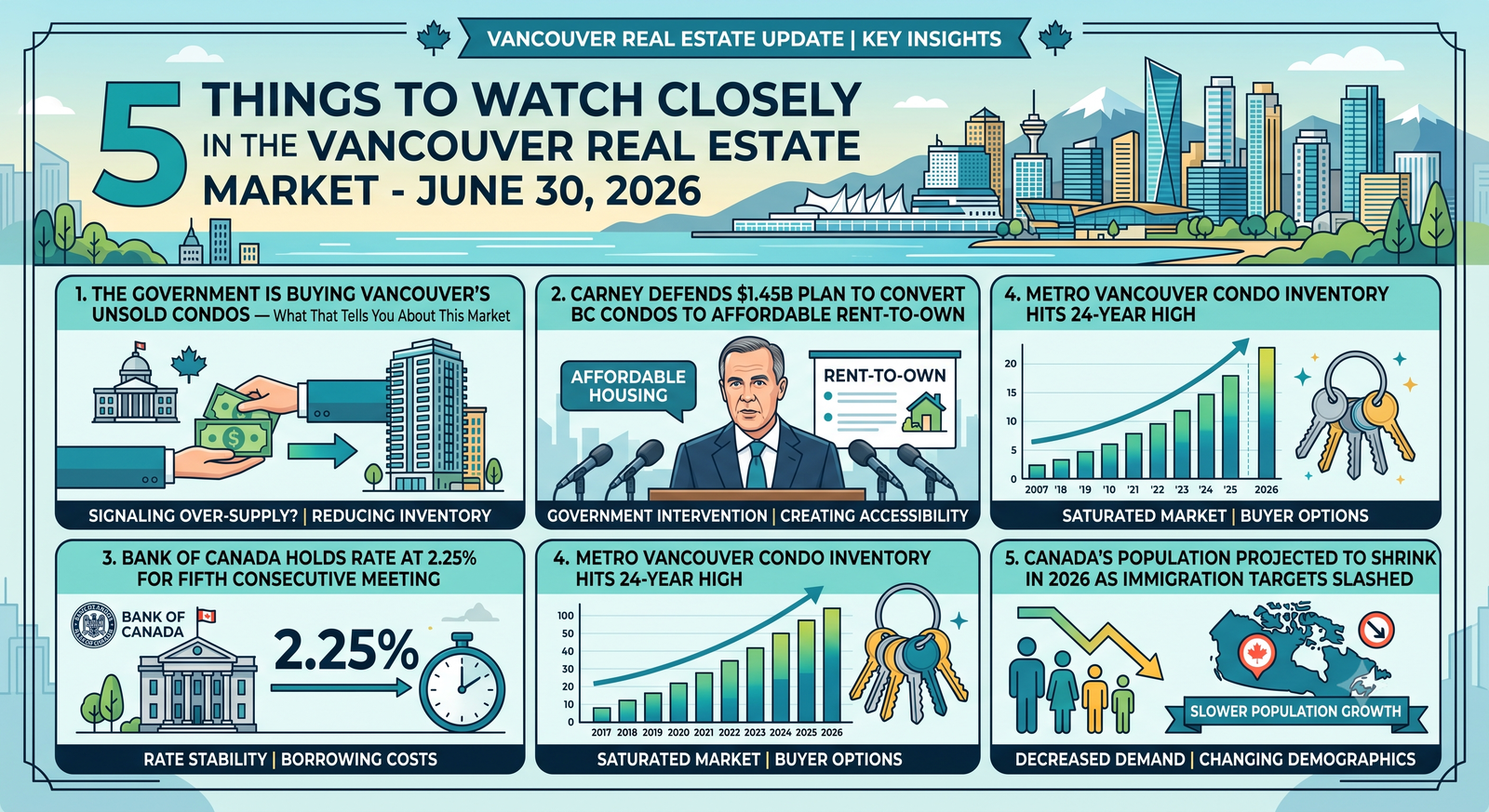
 The Government Is Buying Vancouver's Unsold Condos — What That Tells You About This Market — June 30, 2026
When Ottawa steps in to buy up vacant condos in Metro Vancouver, that's not a housing policy story. That's a market signal.Last week, Prime Minister Mark Carney and BC Premier David Eby announced a $1.45 billion plan to convert more than 2,200 unsold, completed condos across Metro Vancouver into affordable rent-to-own housing. The federal government is covering roughly 10% of the cost. The rest comes from BC and innovative financing structures. Critics immediately called it a developer bailout. Some housing experts called it a potential win-win. I think both camps are partly right — but neither is asking the more important question: how did we get here?
Here's the short answer: 4,376 completed condos are sitting empty in Metro Vancouver right now. That's a 76% increase from this time last year. The unsold inventory picture is the worst it's been in 24 years — worse than post-2008, worse than the foreign buyer tax fallout in 2016. The towers completing today were sold on presale in 2020–2022, when rates were near zero and everyone — end-users, speculators, and investors — was buying anything that had a render and a completion date. Now those completions are landing in a market where the Bank of Canada has held its rate at 2.25% for five consecutive meetings, the condo benchmark is down nearly 8% year-over-year, and buyers are in no rush.
The government isn't buying these units because it's generous. It's buying them because the math stopped working for the developers who built them, and a wave of receiverships would be worse for everyone.
So what does this mean if you're active in this market right now?
If you're a buyer, the condo segment is the most buyer-friendly environment Vancouver has seen in over two decades. Benchmark prices on downtown condos are around $812,000 — down from the peak — with days on market pushing 38 days and sellers increasingly willing to negotiate. The Carney/Eby program absorbs some of the distressed supply, which actually helps put a floor under condo prices over the medium term. If you've been sitting on the sidelines waiting for a crash, understand that government intervention tends to limit downside, not accelerate it.
If you're a seller or an investor who bought presale during the boom, I'm not going to sugarcoat it: you're in the hardest spot in this market. The rent-to-own conversion program will compete with your unit for tenants and buyers. The question is whether to hold through the cycle or take the loss now and redeploy capital. That's a conversation that needs to happen with a full picture of your financing, your timeline, and the specific submarket you're in — Burnaby and Coquitlam are getting hit harder than the West Side.
If you're watching the macro, the Bank of Canada's prolonged hold reflects exactly the tension we're all feeling: a weak economy weighed against persistent uncertainty over US trade policy and elevated energy prices from ongoing Middle East conflict. Rate relief is coming — the next decision is July 15 — but the BoC isn't in a rush, and neither is the market. Layer in that Canada's population is actually projected to shrink in 2026 as immigration levels fall sharply, and you've got a demand story that looks very different from the 2021–2023 narrative.
None of this means the Vancouver market is broken. Detached homes are a different conversation — absorption is tighter and price declines are far less dramatic. Land is still scarce. But the condo market is undergoing a genuine reckoning, and the fact that the federal government felt compelled to intervene tells you everything about the severity of the correction in that segment.
Watch July 15 closely. If the Bank of Canada cuts, that changes the calculus — particularly for first-time buyers financing a condo purchase who've been on the fence. If they hold again, expect this buyer's market to persist well into the fall.
Carney Defends $1.45B Plan to Convert BC Condos to Affordable Rent-to-Own
Summary: The federal government and BC announced a $1.45-billion partnership to convert more than 2,200 vacant, completed condos in Metro Vancouver into affordable rent-to-own housing, drawing both praise from housing advocates and criticism from those calling it a developer bailout.Kevin's Take: I've been watching this condo inventory pile up for eighteen months. 4,376 completed units sitting empty in Metro Vancouver — that's not a blip, that's a structural correction.The government's $1.45B plan isn't charity for developers; it's triage for a market that built on zero-rate assumptions that evaporated. The rent-to-own structure is actually clever: it gets young families into equity-building pathways without requiring a down payment they don't have. The real question is whether the program is structured with enough oversight to ensure those units are actually priced affordably long-term — or whether it just delays the same problems.
I'll be watching the program details closely, because the execution matters more than the headline number here.
Source: CBC News | Daily Hive
Bank of Canada Holds Rate at 2.25% for Fifth Consecutive Meeting
Summary: The Bank of Canada maintained its overnight rate at 2.25% on June 10, citing weak economic activity, persistent uncertainty over US trade policy, elevated oil prices from Middle East conflict, and a desire to avoid letting near-term inflation pressures become entrenched.My angle: Five holds in a row. The Bank is stuck between a slowing economy that needs relief and macro risks that make aggressive cuts dangerous. What this means for real estate: buyers who were waiting for a dramatic rate drop to jump in aren't getting one this month. The next decision is July 15 — and if they cut then, I expect to see conditional offers pick up fast, especially in the attached segment. For now, we're in a holding pattern, and that actually suits patient buyers who want to negotiate rather than compete.Source: Bank of Canada | CBC News
Metro Vancouver Condo Inventory Hits 24-Year High
Summary: Approximately 2,500 unsold newly built condos are sitting in Metro Vancouver — the highest level in 24 years — with the condo benchmark price down 7.9% year-over-year to $697,800 and active downtown listings up 22% compared to June 2025.My angle: The presale buyers of 2020–2022 are completing into a completely different market than the one they bought in. That's just reality. But here's what I keep telling clients: the oversupply is concentrated. Burnaby, Coquitlam, parts of Surrey — those submarkets are getting hit hardest. The West Side, the North Shore, quality Eastside product? Softer, but not collapsing. If you're a buyer who wants a condo, now is literally the best opportunity in a generation to negotiate terms, price, and assignments. The units aren't going to zero — they're just giving ground after years of being unreachable.Source: The Deep Dive | Rain City Properties
Canada's Population Projected to Shrink in 2026 as Immigration Targets Slashed
Summary: Canada is reducing permanent resident targets to 380,000 for 2026 while cutting temporary resident admissions by roughly 43% in a single year, with IRCC projecting a 0.2% population decline in both 2025 and 2026 — the first time in modern history Canada's population will contract.My angle: This is the demand-side story that almost nobody in real estate is talking about loudly enough. The entire bull case for Vancouver real estate over the last decade was anchored to population growth driven by immigration. Now Canada is deliberately engineering a population decline. Rental vacancy has already doubled to 3.7%. Rent is down 20% from the 2023 peak in Vancouver. That's not all immigration-related, but it's a significant contributor. The market narrative needs to update: we are not going back to a 1% vacancy rate any time soon, and investors who bought rental properties banking on that pressure need to plan for a different operating environment.Source: TD Economics | Canadian Mortgage Professional
BC Housing Starts Down Nearly 20% Year-Over-Year; National Starts Held Near Flat in May
Summary: BC saw urban housing starts fall by approximately 19,300 units on an annualized basis, contributing to a near-flat national housing starts figure in May 2026, as financing conditions and soft pre-sales continue to discourage new project launches.My angle: Here's the irony: the supply that was supposed to solve Vancouver's affordability crisis is now stalling out. Developers can't get projects financed when presale absorption is this weak, and no developer launches a tower into a buyer's market with 4,000 unsold units sitting in competing buildings. The construction pipeline is quietly shrinking. That matters 2–3 years from now when this current inventory gets absorbed and there's nothing in the queue. We've done this cycle before — undersupply follows oversupply, and the whipsaw is what creates the next price run. I'm not predicting timing, but I am paying attention to what's not getting built today.Source: Canadian Mortgage Professional | TD Economics
Kevin Lynch is a Vancouver-based real estate agent and market commentator. For market updates, reach out at hello@kevinlynch.ca.
Kevin Lynch is a Vancouver-based real estate agent and market commentator. For market updates, reach out at hello@kevinlynch.ca.