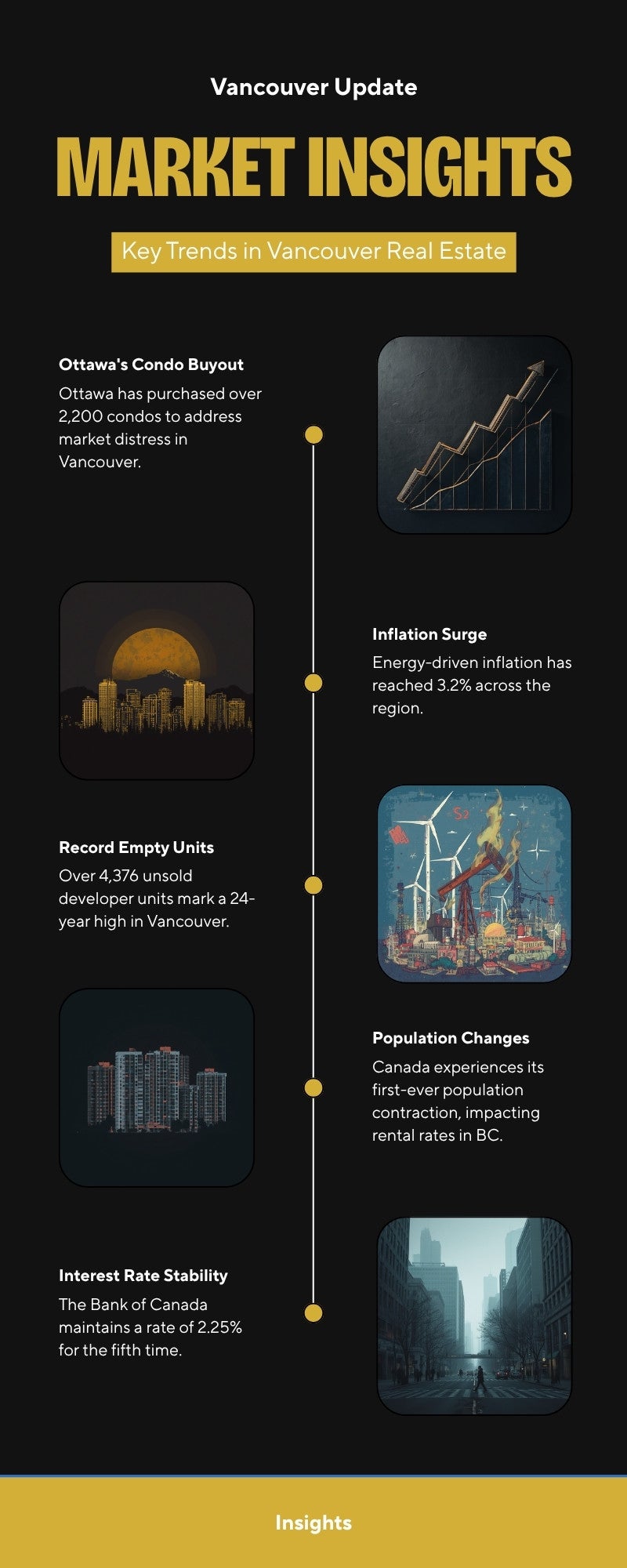
When a government steps in to bulk-buy unsold condos from private developers, that's not a housing strategy — that's a distress signal. And last week, Ottawa gave one of the loudest signals we've seen in years.
The federal government, in partnership with BC Housing, announced it will purchase more than 2,200 completed but vacant condo units across Metro Vancouver and convert them into affordable rental housing. Prime Minister Carney framed it as a win for affordability. But let's be direct: this deal exists because the condo market broke first.
Metro Vancouver is currently sitting on approximately 4,376 completed but unabsorbed condo units — a 76% jump from this time last year, and the highest level of developer-owned unsold inventory in 24 years. Developers in Burnaby, Richmond, and the Coquitlam corridor are offering $15,000 in closing cost credits, throwing in free parking and storage, some are returning deposits because they can't hit presale thresholds.
That's not a soft landing. That's a forced liquidation looking for a buyer of last resort — and they found one in taxpayers.
Here's where it gets interesting for buyers and investors: the government buyout will absorb a chunk of that oversupply, but it won't fix the underlying problem. Royal LePage is still forecasting another 3% drop in Metro Vancouver condo benchmark pricing through Q4 2026, settling around $712,000. Eight months of inventory. Condos down 7.9% year-over-year at $697,800. These aren't numbers that reverse quickly, especially when population growth has flatlined.
Canada just recorded its first-ever population contraction after years of immigration-fuelled demand. The rental market — which was supposed to catch all those newcomers — is also softening. Six BC cities are posting double-digit rent declines year-over-year: Burnaby down 10.5%, Richmond down 9.7%, North Van down 8.8%. The demand tailwind that propped up this market for a decade is no longer a given.
Layer on top of that: inflation ticked up to 3.2% in May — driven by energy prices tied to Middle East instability — which is putting quiet upward pressure on fixed mortgage rates even while the Bank of Canada holds its policy rate at 2.25%. The BoC has held five consecutive times and isn't expected to move until at least the July 15 announcement. Bond markets, however, are already repricing. Fixed rates in BC are sitting near 4%, variable around 3.4%.
What does all this mean on the ground right now?
For buyers: this is a real window. Developers with inventory are motivated. The government buying program may create a price floor in certain segments, but it won't eliminate your negotiating power in the near term. Get off the sidelines and engage. Make offers. The sellers are at the table.
For sellers: if you're listing a condo in the Burnaby-Richmond-Tri-Cities corridor, you are competing against newly built inventory and a government program that is essentially validating the discount. Price accordingly — or wait for conditions that aren't coming back soon.
For investors: the detached market is holding better. Benchmark prices in the Lower Mainland are essentially flat month-over-month. If you're playing the long game with multi-family or detached, the market is quietly resetting to a base that looks sustainable. The condo carnage doesn't mean the whole market is broken — it means one segment overcorrected on the supply side, and the reset is playing out in real time.
I've been through enough cycles to know: when governments start buying assets from developers, the bottom isn't far off. It may not be today. But the pieces are moving.
Kevin Lynch is a leader in the real estate industry with 36 years of experience in sales, marketing, coaching, training. He is a published author and speaker and has been interviewed in the media many times including TV, Radio, newspapers and magazines.
Thinking about your next move? Let's talk. | hello@kevinlynch.ca | kevinlynch.ca | 604-307-9448